Offering multiple payment solutions—especially for your mobile shoppers—is essential for the optimal operation of your e-commerce business. At its core, an online payment method allows you to process payments, create a checkout page, and provide payment-related services to boost sales. The most important factor in selling more and better is having a user-friendly interface to manage these processes. Use this guide to discover the best payment solutions for your e-commerce business.
PayPal
PayPal has been around longer than Stripe. Of course, these aren’t the only solutions on the market. However, PayPal is one of the major players in the market; in fact, it’s used as a payment method on most e-commerce platforms, such as WooCommerce and PrestaShop—as we mentioned in our previous article—as well as Shopify. This platform has several advantages and a few disadvantages. PayPal’s number one advantage is its strong brand recognition, which inspires confidence in online shopping.

Many users know that when they make purchases on this site, the risk of fraud is virtually nonexistent. In addition, in the event of a problem, they are protected and can contact the brand to file a complaint. For bloggers, sellers, and YouTubers, it’s also a very easy way to receive payments securely.
With PayPal, managing payments is really intuitive. You can pay by credit card through PayPal, which is a real advantage. For more information on the new rates, we recommend visiting the website to see the latest updates.
Paysite Cash
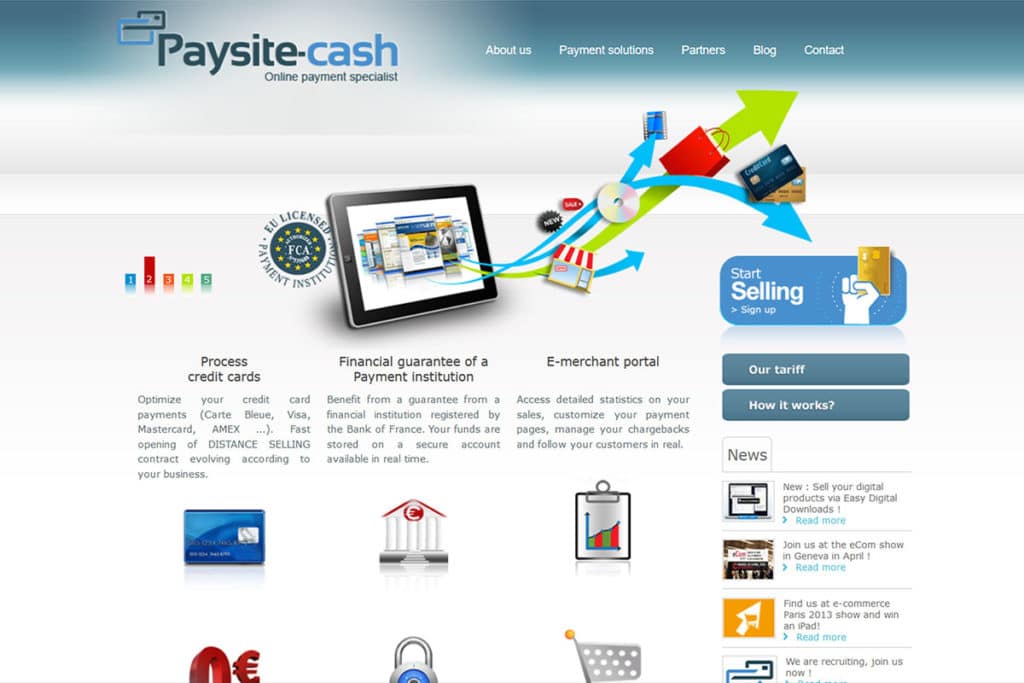
Paysite Cash is a good alternative to Verifone and PayPal. As for fees, you still don’t need a distance selling contract. The platform offers a subscription plan with no commitment. The advantage of Paysite Cash is that the payment process is very quick.
In particular, this method is rarely used and is not yet widespread enough, which may raise doubts among your customers. You cannot customize the sales page. Therefore, you won’t be able to add your logo or branding, and this may discourage customers from making a purchase. The site also lacks intuitiveness.
Stripe

First of all, Stripe is generally less expensive than PayPal. Stripe’s base rate is 1.4% in fees for sales made with European cards, plus 25 cents. For non-European cards, the rate is 2.9% plus 25 cents per transaction. While this does come at a cost, the rate is lower than PayPal’s. PayPal, on the other hand, primarily offers tiered pricing. PayPal’s base rate is approximately 3.4% per sale plus a 0.25% fee.
It’s clear, then, that payment security is a significant expense for the company. It’s essential to build trust with the buyer. Stripe makes managing subscriptions easier. This alternative is becoming increasingly popular. The payment process is extremely quick. And thanks to the intuitive interface, you’ll be able to manage your payments with ease.
To get the most out of the site, it is recommended that youhave an SSL certificate to improve security on the platform.
Paygreen

Paygreen is a highly convenient online payment solution designed specifically for e-commerce. This solution has been available in France since 2015 and has more than 3,000 customers. Paygreen specializes in online payments for e-commerce and marketplaces. The platform makes it easier for e-commerce merchants to integrate certain services and manage payments. Paygreen offers marketplaces a transaction management environment for each of the marketplace’s sellers.
What sets Paygreen apart is that it is the first payment solution to address social and environmental issues. This is reflected in two socially responsible options it offers. One is online rounding, and the other is Tree, a new innovation. You can learn more on the Paygreen website. Tree is an algorithm that calculates the CO2 emissions associated with an online order. Consumers are then given the option to offset those emissions directly on their payment page at the time of purchase.
This allows retailers to enhance their image and build customer loyalty. In addition, consumers will be able to shop in an environmentally responsible way.
Verifone

Verifone works with all banks, both French and Belgian. The payment page is customizable. This helps build trust with the customer. The customer can then enter their banking information, knowing they are on the correct website.
Verifone is very secure, and customer support is very responsive. It’s also reassuring as an e-commerce merchant to know that when you have a problem with a specific service, you know who to turn to for advice. To set up Verifone on your website, you need to sign a distance selling merchant agreement.
Payzen

Payzen’s login-based payment method allows users—once their customer accounts are activated—to make purchases on your site without having to re-enter their banking information each time. This payment method is a real advantage for building customer loyalty, increasing impulse purchases, and simplifying subscription management. We’ll explain the basics of login-based payments as well as the specific features related to the back office.
A user opens a customer account on an e-commerce site. This account is linked to one or more credit cards. In the latter case, the Payzen payment platform creates a card account for each card. Before the customer account is approved, the site verifies the banking information in real time.
PCI DSS compliance allows the platform to store and secure data. For one-click payments, the request is made in real time by sending an HTTP form or via a web service from the merchant’s website. For subscription payments, the merchant site can choose to delegate the management of payment due dates to Payzen via an HTTP form or web service, or to manage the due dates itself and communicate them to Payzen via a file.
Payplug “Ingenius’s Choice”

What’s interesting about Payplug is that there’s no need to sign a distance selling contract. If you don’t want to go see your banker to work out certain details, you’ll be glad to know that this platform works pretty quickly. The payment page is also customizable. Payment processing is well-managed, similar to Verifone, and you have security tools at your disposal. Likewise, customer support is usually available. It’s nice to have someone who responds with precise, personalized answers. There are no setup fees or long-term commitments with Payplug. Check out this service now!
Above all, the rates are very competitive. For a subscription of 10 euros per month with no commitment, they charge a commission of 1.6% and 0.25 centimes per transaction. The rate is on a sliding scale based on volume. The more you sell, the more revenue you generate, and the lower the commissions they’ll charge you.
Mollie

Mollie is a highly versatile alternative to Stripe that will help you launch your business in several European countries if you choose to do so. This platform offers several advantages. It supports dropshipping. You no longer have to worry about your funds being frozen overnight.
Mollie lets you add several reliable payment methods to your website in just a few clicks. Signing up for this platform is simple and takes less than 15 minutes. Be sure to fill out the required fields correctly. Your personal information must be provided without any errors.
Amazon Pay

Amazon Pay lets you make seamless payments on e-commerce sites using your Amazon account. With this new solution on the market, shop with confidence. Your purchases are protected by a reliable security system.
The Amazon Pay solution is a major innovation for the millions of internet users who will be able to pay for their purchases as easily as possible. Payments are processed using information previously collected from their Amazon accounts.
Take advantage of the reliability offered by thise-commerce giantto provide your prospects with a payment experience they can trust. With this alternative, you can reduce the rate of abandoned carts.
Traditional methods
It’s not always something you think about when you launch an e-commerce business, but it’s a good idea to keep an eye on traditional payment methods. They’re still used on some websites. You can pay by check or bank transfer.
The check

In fact, checks take a little time, because when there’s no one there to accept them, the transaction usually takes a few minutes. Overall, all of these payment solutions are effective. This allows businesses to diversify their payment methods. It’s important to note that the current trend is still toward reducing check payments due to unpaid bills.
Some banks advise against using this method. Nevertheless, it is a good alternative for online payments. However, there are fairly strict guidelines for writing the check, which can slow down the process and make people less inclined to use it.
The Wire Transfer
In our opinion, bank transfer is the best traditional payment method. This method is relatively fast and very secure, and the process is handled by a bank. As a result, there is no risk. Above all, you must carefully verify that you have received the amount due under the correct order reference. In this scenario, traceability is very important.
Mandates
Mandates are becoming less common, but they still exist. They can also be a very good alternative, depending on your clientele and their needs. Don’t hesitate to offer them—it’s definitely a viable option.
Payment upon receipt

If you have a brick-and-mortar store, payment upon pickup would be ideal. When a customer places an order, they stop by the store and pay you. It’s a kind of “click-and-collect” system, except that payment is made in person.
With all these payment options available, you’ll certainly be spoiled for choice. So opt for the most popular platforms that offer greater reliability, such as PayPal and Stripe. All of these payment methods, however, ensure that your sales are managed effectively. Be sure to check out their official websites to get a clearer idea of the various offerings and features available.