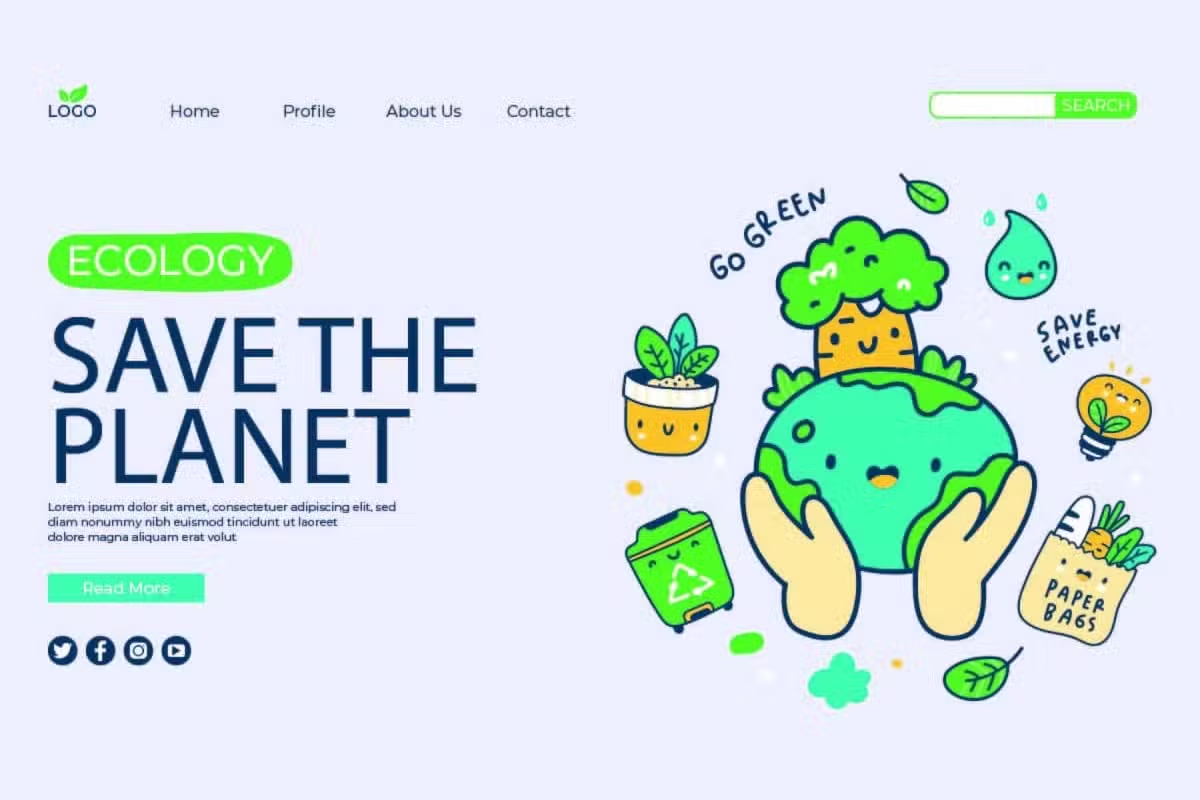
Over the past few years, a term has gradually found its way into our vocabulary, gaining in importance and relevance:environmental responsibility. Beyond the traditional boundaries of industry and agriculture, this concept has begun to carve out a prominent place for itself in the digital realm.
The digital realm, once considered intangible and therefore inconsequential to our planet, is now emerging as a major environmental factor. Indeed, the infrastructure needed to support our connected world—servers, networks, and devices—consumes a considerable amount of energy and produces a significant amount of greenhouse gases.
From design to hosting, including maintenance, every stage of a website’s lifecycle has an impact on the environment. To protect our beautiful planet, we must take these factors into account from the very beginning of the website creation process. This awareness is all the more important because it not only helps preserve our planet but also reduces costs and enhances brand image.
This issue has finally become a major concern in the digital world. The need to take action continues to grow as our dependence on technology increases. In this article, we’ll explore why and how to incorporate this concept into your online business.
Understanding the Environmental Impact of the Web

Server Energy Consumption
Servers are the beating heart ofthe Internet. They host websites, applications, and online services, making information accessible anytime, anywhere. As you might expect, keeping these resources available around the clock requires a significant amountof energy.
Every request, every click, and every page load involves a server somewhere in the world. These machines run continuously, day and night, to ensure that data is available when we need it. This constant activity results in significant energy consumption.
That’s not all—these data storage units generate a large amount of heat. To prevent overheating and ensure they function properly, high-performance—but energy-intensive—cooling systems are required. Thus, operating servers presents a twofold energy challenge: ensuring they function properly and maintaining their temperature at an appropriate level.
The energy required for each online interaction
Even if we set aside the issue of servers, every interaction we have on the web still consumesenergy. Whether we’re reading an article, conducting a search on a search engine, watching a video, or sending an email, each of these actions uses its share of energy resources.
On the one hand, there isthe energy consumed by our devices—computers, smartphones, and tablets. On the other hand, there isthe energy required to transmit data between our devices and servers. The latter depends on many factors, including the distance between the device and the server, the type of internet connection used, and the volume of data exchanged.

Given that every online interaction has an energy cost, and considering the growing numberof Internet users and the amount of data exchanged every second, it is easy to imagine the enormous cost that accumulates over time.
Web Page Size and Its Impact
Another important factor that influencesthe web’s ecological footprint is the size of web pages. The size of a web page refers to the total amount of data it contains, including text, images, videos, scripts, and other interactive elements.
The heavier a page is, the more resources it requires to download and display. Large, uncompressed images, high-definition videos, complex animations, and heavy scripts can increase the size of a web page, which results in higher energy consumption when the page loads.
Reducing page weight is therefore essential to minimizingthe web’s environmental impact. This can be achieved through various optimization techniques, such as image compression, removing unnecessary code, caching content, or using more efficient file formats.
The Importance of Minimizing Environmental Impact
Given the significantenvironmental impact of the Internet, it is more important than ever to take a thoughtful approach to the design and management of your websites in order to make a meaningful contribution to reducingthe overall ecological footprint.
Eco-friendly design takes into account not only the user experience and business objectives, but alsothe impact of every design decision. This may include choosing green hosting solutions, optimizing resource usage, using efficient code, and adopting energy-efficient practices.

Reducing your carbon footprint isn't just good for the environment. These efforts can also improve the user experience, lower hosting and bandwidth costs, and strengthen your brand image by demonstrating a commitment to sustainability.
Understand that minimizing the web’s environmental footprint isn’t just a responsibility—it’s also an opportunity. By taking a responsible approach, we can help preserve our planet while creating a faster, more efficient, and more enjoyable web for everyone.
Environmental Responsibility: An Asset When Redesigning Your Website
Website Redesign: An Opportunity Not to Be Missed
When it comes to redesigning a website—as mentioned in our guide on the methods and pitfalls of website redesign—the main goal is often to improve the user experience or modernize the design. However, it’s also the perfect opportunity to incorporate a green approach into your brand strategy.
A redesign offers a unique opportunity to rethink and reshape every element to make it more suitable. As we mentioned, this may include reducing the size of resources, minimizing server requests, or adopting energy-efficient coding practices.
Beyond the Redesign: A Long-Term Commitment
Your concerns shouldn't be limited to the redesign phase. This is a long-term commitment that must be taken into account in all decisions regarding your site, fromhosting to maintenance to the choice of WordPress plugins to integrate.
The harmony between aesthetics and environmental responsibility
The Balance Between Design and Sustainability
According to our online booking site developers, a common misconception is that eco-friendly design means sacrificing aesthetics in the name of sustainability. Set aside those misconceptions and understand that an attractive design and eco-friendly performance are not mutually exclusive. On the contrary, an optimized site will not only load faster but also provide a smoother user experience.

Eco-design as a Source of Inspiration
This approach can serve as a source of inspiration for creating innovative designs. By striving to minimizeyour environmental footprint, you can discover new design approaches that make your site not only more sustainable, but also more unique and memorable.
Optimization and aesthetics: two sides of the same coin
Many optimization techniques can actually improve the site’s visual appeal at the same time. For example, optimizing images can not only reduce their file size but also improve their visual quality. Similarly, reducing unnecessary scripts and animations can make a site run more smoothly and be more enjoyable to navigate.
The Benefits of an Eco-Friendly Theme
Choosing a “green” theme can help you combine energy efficiency with good design. These themes are designed to be lightweight and fast, while offering a wide variety of customization options to create a website that aligns with your brand image.
Transition: From E-commerce to Environmental Commitment
The Future of E-Commerce: Sustainable and Efficient
The shift towardeco-responsibility in e-commerce is not only beneficial forthe environment but can also offer tangible business advantages. An eco-responsible e-commerce business can attract environmentally conscious customers, improve website efficiency, and even reduce costs in the long term. This is a vision for e-commerce that we are proud to support and promote.

The Importance of Committed Partners
In addition to choosing eco-friendly platforms, you should work with partners who share this commitment to sustainability. This includes web hosting providers, payment service providers, and even logistics companies.
CMS Migrations: For the Good of All
With the explosion of e-commerce,the web’s carbon footprint has never been a greater cause for concern. E-commerce platforms, with their vast volume of transactions and data, have a huge impact on this issue. That’s why you need to choose eco+ solutions for your online businesses.
For clients who wish to switch CMS platforms, our agency offers “green” migration services. We guide you through the entire process, ensuring that your new website is optimized to minimizeits environmental impact while delivering a high-quality user experience. To learn more about our services, visit our dedicated pages“Switching from Shopify to WooCommerce”or“Switching from Wix to WordPress.”
Our Eco-Friendly Services

Creation of Eco-Friendly Booking Websites
At Ingenius, we are committed to designing “green” websites for clients who want them. We offer website development services that takeenvironmental impact into account at every stage of the process, from design to maintenance. By combining energy efficiency with attractive design, our solutions help businesses achieve their goals while reducing their environmental footprint.
"Green" Initiatives at the Local Level
As an established agency, we are particularly proud of our commitment to promotingenvironmental responsibility within local communities. In Nantes, for example, our Nantes website design services andour Nantes WordPress agency are designed to help Nantes-based businesses stand out online while minimizing their environmental impact.
A Partner Committed to a Sustainable Web
By choosing us, you’re choosing a partner committed to promoting a sustainable web, as we strive to offer eco-friendly services at the cutting edge of innovation, helping businesses achieve their goals while preserving the environment for future generations.
In conclusion, the need for environmental awareness in the digital world
Environmental responsibility is no longer just an option for online businesses; it has become a necessity. Awareness ofthe web’s environmental impact has transformed the way we design and operate websites. From reducing energy consumption to minimizing resource usage, every aspect of website design can and must be optimized for sustainability.
Choosing an eco-friendly approach for your website isn’t just good forthe environment. It’s also an effective strategy for improving the user experience, optimizing website performance, and positioning your company as a responsible business. Let’s makeeco-friendliness the norm—not the exception—for the web of tomorrow.
Adopt an eco-friendly approach with Ingenius
We are proud of our commitment to a greener internet, and we invite you to join us in our mission to create a more sustainable web. Contact us today to discuss how we can help you achieve your online goals while minimizing your environmental footprint. Together, we can make a difference for our planet while building a brighter digital future.