

Elementor

Why use Elementor?
Elementor is a tool designed to make designing and maintaining WordPress pages as simple as possible. This tool replaces the Gutenberg editor typically offered on the platform and provides a freemium service that has generated a great deal of interest among users.
A free tool
One of the main reasons Elementor is so successful is certainly because it’s a free plugin. You can install it for free on your WordPress site. You can do this directly from the dashboard by going to the “Plugins” tab and then clicking “Install.” Unlike other page builders such as Divi Builder or Visual Composer, which are available only as paid versions, Elementor offers a free version. Even with the free version, you can create great layouts.
Leaves no trace after deactivation
The Elementor tool can be described as “clean” because if you ever deactivate the plugin, you won’t have to clean up any traces left behind by a page builder. These are generally referred to as shortcodes. Such traces are often left behind after deactivating a plugin. You won’t see that with Elementor.
Easy to learn
The Elementor plugin lets you bypass the native WordPress interface and the Gutenberg page editor. It’s more intuitive and easier to use. You can see the changes you make in real time thanks to its page builder. Plus, you can work with the drag-and-drop feature without any restrictions. It’s easy to use, even for beginners who have never used a similar tool for website creation before.
Theme Builder Feature
In reality, this plugin is a page builder. You get everything with the free version. However, the tool also includes a theme builder feature. The difference between these two options lies in the amount of content they can generate. The new version of the extension is useful for building the header and footer, unlike the page builder, which doesn’t allow you to do all that.
In addition, almost all themes and plugins are compatible with Elementor. The Elementor and Elementor Pro extensions are updated very frequently. This ensures that bugs are fixed and improvements are made on an ongoing basis. If any issues arise, the plugin’s developers address them promptly.
At first, page builders didn’t have a good reputation: they were very resource-intensive, very slow, and very cumbersome—especially for SEO. Fortunately, things are different today; opinions have changed, and Elementor no longer slows down pages, let alone entire websites.
Layouts to Download
Various page builders offer the ability to download pre-built layouts. The free version, however, doesn't offer many options in this regard. If you opt for a pro version, you'll have a wide selection of attractive, ready-made layouts to insert into your pages. This feature will allow you to create professionally designed pages with relative ease.
What are the benefits of Elementor?
 A powerful and easy-to-use page builder A massive ecosystem Flexible developer roles
What are the drawbacks of Elementor?
 Some important paid options A bit tricky for beginners to get the hang of Slow loading of certain website pages after installing the plugin
Elementor Overview
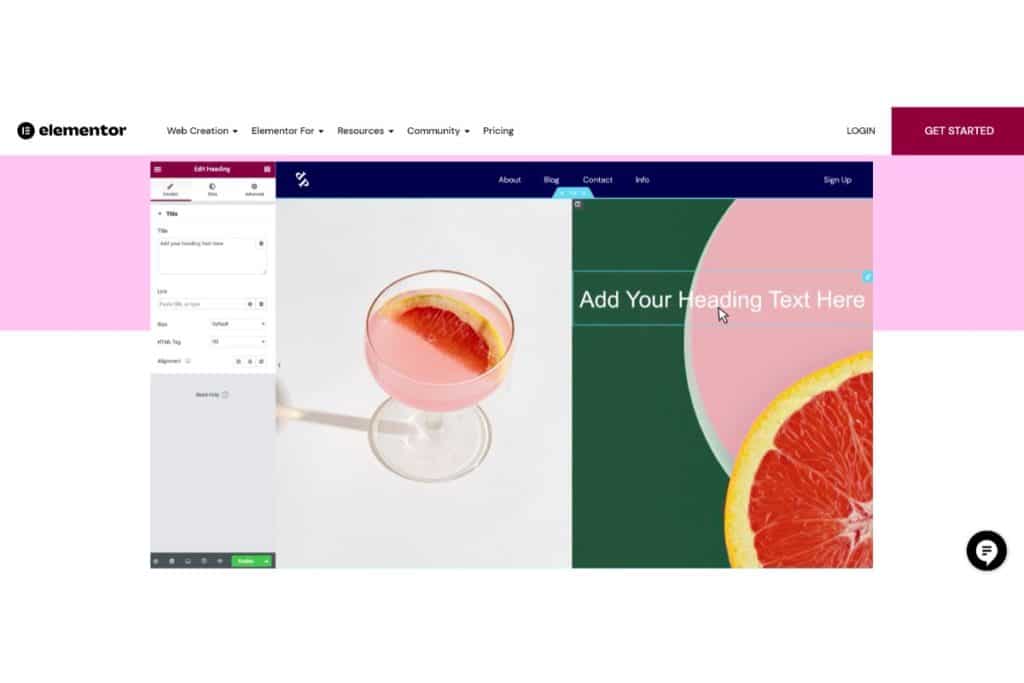
Complete description of the tool
The success of this plugin lies primarily in its ease of use. The site’s interface is designed to ensure a satisfying experience. The tabs and various settings are also worth noting as soon as you open Elementor.
Overview of the Interface
On the left, you'll see a column with all the settings, features, and widgets. On the right, you'll have access to the page you're currently editing, as well as an immediate, real-time preview of the changes you make. This means you won't need to refresh the page or open it in a new tab to view the content.
For most changes, all you need to do is click and drag. However, this does depend on the type of page you want to create. For “About” or “Who We Are” pages, you can do without this feature. It’s possible to achieve excellent results without using the usual drag-and-drop functionality. However, when it comes to creating dynamic pages like homepages, it’s hard to do without this option available with Elementor Pro.
Elementor Settings
When you activate the plugin, two new tabs appear: the Elementor tab and the Templates tab.
The Elementor tab has three additional sub-tabs. The Style tab and the Advanced tab let you configure a few additional options, and the General tab is the one you’ll use most often. To access the General tab, go to Elementor and then click “Settings.” Next, open the “General” tab, which lets you specify the content types you want to edit with Elementor. Posts and pages are selected by default.
To work more efficiently, it’s best to create pages using a page builder and use the WordPress editor for posts. Elementor’s default colors can be disabled. This allows your theme’s colors to take precedence. Do the same for fonts, since fonts available in Elementor themes do not appear in its widgets. The plugin may collect information anonymously. Finally, be sure to save your changes. Additionally, the Elementor tab contains other tabs such as:
- Tools tab;
- Role Manager tab;
- Custom Fonts tab;
- Systems Information tab.
To enable Elementor for a piece of content, go to the "Page" tab and then click "Add." Enter your page title, enable the Page Builder, and then wait a few moments for your page to open on the front end.
The "Template" tab, on the other hand, is essential for saving a layout. The advantage is that this layout can be used on another page. Be careful, however, because the template library in this tool is indexed by search engines.
Tool Structure
Elementor has a large community. Bloggers, developers, and other users looking to grow their businesses are giving it a try. It’s an excellent plugin with outstanding usability.
It’s worth noting that the plugin’s translation is only partial. In fact, when it comes to the theme builder and certain settings for the Pro widgets, Elementor’s translation has some shortcomings: although the documentation and support are understandable, they are available only in English. However, it remains easy to use, even for those who aren’t very comfortable with English.
Our Opinion
WordPress is a website-building platform that can sometimes be difficult for beginners to get the hang of. That's where the Elementor tool comes in.
This is a page builder designed to design and structure web pages. All of this is done in record time. With this tool, you can create any layout. The page content is laid out just as well, regardless of the theme installed on the site. With the drag-and-drop feature, reorganizing pages is a breeze. Maintaining the site is very easy since everything is done via drag-and-drop. Elementor thus saves us valuable time.
In August 2020, Elementor 3.0 was released. This major update introduced new features. The design system, theme styling, and settings were completely redesigned, resulting in a brand-new and highly appealing page builder. Elementor is a plugin that continues to evolve and be updated, much to the delight of its many users.
We therefore highly recommend using the plugin not only to make it easier to create your website but also to save a lot of time in the design process.
In the same category
 Easy to learn Excellent design A large user community
 Extensive design library Complete visual redesign of the websites Ability to customize a WooCommerce store
 Access to a wide variety of elements for creating dynamic content Access to a variety of content customization options Ability to organize content using multiple layouts