
WordPress is becoming increasingly popular these days. As soon as you start using it, you’ll encounter several new terms. These include themes, keywords, plugins, the sidebar, and categories, among others. It’s easy to get confused with so many different terms. You’ve probably also come across the term “widget” several times. Basically, the term “WordPress widget” refers to modules that are embedded in a specific area to provide specific information to a site’s visitors. As defined, these widgets are no longer available since the release of WordPress 5.8.
However, it is still possible to populate widget areas. To do so, though, you'll need to use blocks. In this article, we'll help you learn everything you need to know to manage your widget areas effectively.
The Evolution of the Widget Concept
As you may know, the widget feature no longer exists. These days, the widget editor works with blocks, just like the WordPress content editor. If you're used to using the latter, you won't have any trouble figuring it out.
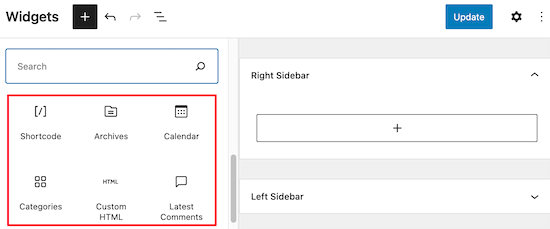
The widget areas will therefore always be available to you. You’ll just need to add blocks to them. Which blocks you use depends on your needs. These can include paragraphs, images, headings, or any other blocks you deem necessary.
Blocks give you a great deal of creative freedom compared to the old widget editor. Whether you want to display your blog’s latest posts, show a list of your categories, or view the most recent comments, everything is still accessible.
To include them , go to the “Widgets” category in the editor . The same applies to other blocks, such as social media icons, or those provided by your theme or plugins. Also, keep in mind that if you’re already used to using the old widgets on your WordPress site, they’ll continue to work as usual. They’ll be accessible within the “Old Widget” block.
How do I include blocks?
If your theme has one or more widget areas, you can add blocks to them. To do this, go to “Appearance” and then “Widgets .” If this menu isn’t available, it means your theme doesn’t have any widget areas.
Most themes have at least two widget areas. The first is the sidebar. The second is the footer .
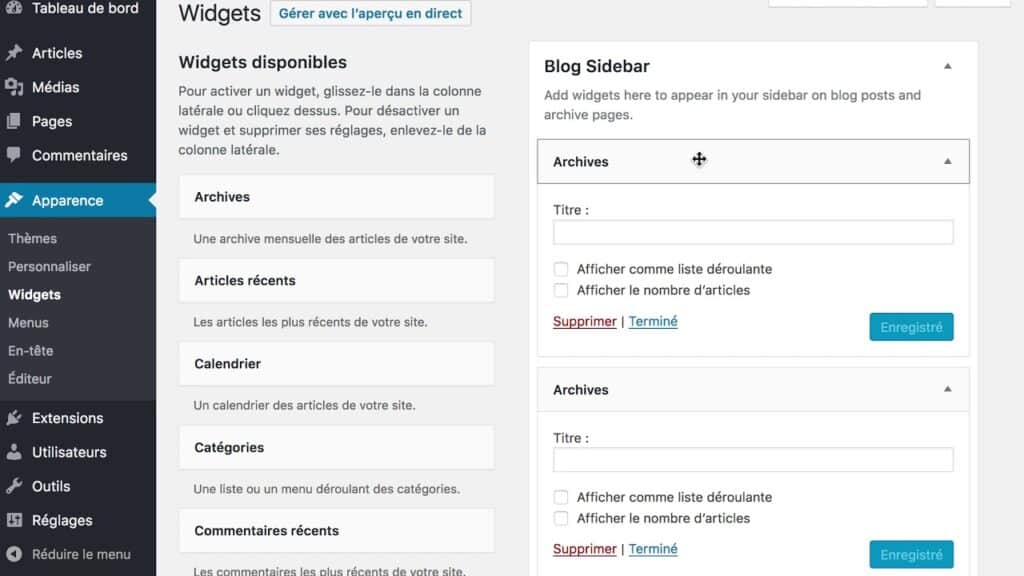
When you want to temporarily remove items from your widget areas, you can move them to the "Disabled Widgets" section. This section is located at the very bottom of the page and functions like an invisible widget area. Its main advantage is that it allows you to keep the various settings for your blocks and widgets intact.
To view your various changes in real time, it’s important to use the customization tool. To do this, go to the “Appearance” menu, then “Customize,” and finally “Widgets.” If your theme has multiple widget areas, you’ll first need to select the area you want to edit.
To make the preview as close to reality as possible, enable the "Hide Controls" option. This provides a preview that’s almost exactly like how WordPress widgets appear. It’s also important for you to know how to add and move various elements within your widget areas.
How can you successfully coordinate widget areas?
To add a block to a widget section, click the “+” icon located either before or after an available element. It may also be found on the button-like icon at the bottom of the area. To view the available blocks, click “Browse All” or enter the block’s name.
If blocks or widgets aren't displaying properly, group the components that need to be in the same column. Grouping WordPress widgets or blocks together ensures that they are aligned as desired.
When the various block options within an interface are similar to those in the content editor, the process is straightforward. You’ll see the“Copy,” “Duplicate,” and “Insert Before and After” icons.
You can also move, group, or remove a block, or adjust settings specific to each block. An arrow icon helps you move a block to another widget area, as well as to the area for disabled widgets.
If you’re no longer happy with the placement of one of your blocks, you can move it around within the widget area. To do this, simply use the up and down arrows via a standard drag-and-drop action—just as you would with blocks in your posts.
So you can move a widget just like a Gutenberg block. To do this, click the arrows provided or use drag-and-drop. If you're familiar with the block editor, it's not complicated at all.
What blocks are available in the widgets category?
Thanks to WordPress, you have access by default to about fifteen blocks in your widgets category. In fact, they essentially correspond to the old WordPress widgets. These blocks allow you to do various things and serve a variety of purposes.
The WordPress Shortcode Block and Its Features
The WordPress Shortcode block, as its name suggests, allows youto embed a shortcode. This lets you insert specific content—such as a gallery, a form, or a video—often from a plugin. However, given the wide variety of blocks available, the chances that you’ll need this one are pretty slim.
The WordPress Archives Block and Its Features
This type of block is useful for displaying monthly archives of posts on your WordPress site. When a month is displayed, it means you published at least one post during that month.
The Archives widget has options that allow it to display as a drop-down list. Instead of showing a list of links, this option displays a drop-down list instead. Within your widget area, this can save you a considerable amount of space.
The Archives section also lets you view the number of posts. Selecting this option shows you the exact number of posts you've published each month, either in the links or in the drop-down list, if the latter is available.
This block can therefore give you an idea of how consistently you’ve been posting. However, the various links it provides are rarely used. This could cause you to waste space in your widget areas. The best approach when you want to display your archives is to create a dedicated page to house this block.
The WordPress Calendar Widget Block and Its Features
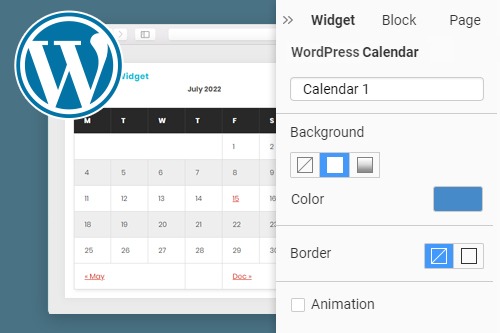
The purpose of this block is to display a calendar that shows today’s date. As for the days when articles were published, they are listed using links that lead to the archive page for that day, which lists the various articles published on that date. This is a block you won’t actually need.
The WordPress Categories Widget Block and Its Features
This block lets you display a list of your WordPress site's categories. The options in the Categories block are therefore quite useful. You can use it to display a drop-down list.
In fact, rather than displaying a list of links, this option allows you to display a drop-down list. This gives you the opportunity to save space within the widget area. This block also allows you to display the hierarchy.
When you use subcategories, you can highlight them by displaying the category tree. You can also display the number of items, since selecting this option shows the number of items in each category.
If your categories aren't included in any menu, using this block can be helpful for guiding visitors through the intricacies of your site. When you want to display only a few categories, it's better to use the Navigation Menu block.
The Custom HTML WordPress Widget Block and Its Features
By using the custom HTML block, you can ensure that HTML code is added to your widget area. This allows you to insert specific data, such as a Google Maps embed code.
Once you’re comfortable with what you’re doing, you have the flexibility to write your own HTML code. However, you can also accomplish this task using the other available blocks. Therefore, this block should be used sparingly. It can be useful in certain situations, such as when inserting a specific type of content into widget areas.
The WordPress "Latest Comments" Block and Its Features
The WordPress "Latest Comments" block lets you display the most recent comments left by your visitors. Among other things, this block displays the avatar, date, excerpt, and the number of comments to be published.
The WordPress "Latest Posts" Widget Block and Its Features
With this block, you can display a list of recent posts published on your blog. This block offers several options, such as displaying the full content of your post or just an excerpt. It also allows you to display the author’s name, the featured image, and the publication date.
You also have the option to sort and filter your recent posts by author, publication date, or category. You can also choose how many posts the block should display. This is a very useful block for showcasing your latest news. Whether placed in a footer or a sidebar, its importance is undeniable.
The WordPress "List of Pages" Widget Block and Its Features
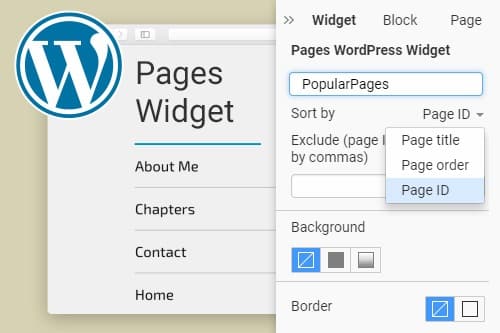
With this block, you can display all the pages on your site. However, the usefulness of this block has not been proven. You’d be better off using the menu block, which allows you to choose the specific pages you want to display.
The WordPress RSS Widget Block and Its Features
This block is designed to display the content of an RSS feed on your WordPress site. For your information, an RSS feed is essentially a list of posts from a blog or news site. It can also be thought of as a personalized category or tag. This block would not be beneficial to you unless your goal is to drive visitors away.
The WordPress Social Media Icons Widget Block and Its Features
By using this block, you can add icons that link to your various social media pages. This block can also help you customize both the shape and color of your icons, as well as their background.
It's hard to find a better way to drive traffic to your social media accounts and, potentially, attract new followers and fans. It would be a great addition to your sidebar or footer.
The WordPress "Tag Cloud" Widget Block and Its Features
By using this block, you can display a large number of tags used on your site. Each tag will appear in a size proportional to the number of times it has been used. This block also allows you to choose whether to display categories or tags.
You can also specify the number of items categorized under this group or tag. However, this block isn't really useful, since no one uses it to navigate a website.
The WordPress "Old Widget" Block and Its Features
This block lets you display an old WordPress widget. You can also view a widget provided by a theme or a plugin. This block is useful because it displays widgets added using the old widget editor.
WordPress therefore handles the conversion immediately. This is a block whose usefulness isn't necessarily clear unless the widget isn't available as a block.
The WordPress Search Widget Block and Its Features
If you want to give your visitors the flexibility to search your site, this block can be useful. It allows you to insert a search field into one of your WordPress theme’s widget areas. It also lets you select the block’s display width.
If your blog has only a few posts, this is a block you shouldn’t use. After all, it would be easy to browse through everything. This is especially true because most themes already include a search field, usually in the header. So this block won’t be very useful to you.
The WordPress Meta Widget Block and Its Settings
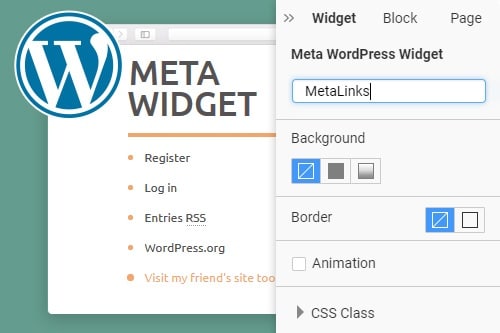
Through the Meta block, you—as the site’s webmaster—have access to a series of links. This block contains a link to the admin panel, a login/logout link, and a link to the RSS feed for articles.
In addition, you can include a link to the comments RSS feed and a link to the WPFR association’s website. However, this block is unnecessary for your many visitors. We therefore do not recommend using it.
The WordPress Navigation Menu Widget Block and Its Features
Finally, this block is important because it allows you to display a navigation menu in a widget area. This block lets you enter the text you want to display before your menu. It also lets you select the menu you want to display from the drop-down list.
This is true even if you only have one. It is a very important block and therefore essential. When you have a lot of content on your site, it will be useful in your footer. However, be sure to use it only when necessary.
WordPress Widget: At a Glance
Since the release of WordPress 5.8, the widgets screen has completely changed. This step-by-step article takes the time to walk you through the process, point by point. So now you know what to do, thanks to this comprehensive guide to WordPress widgets.